
The rapid rise of AI-generated content has made it increasingly difficult to tell what online activity comes from real people and what comes from machines. Deepfakes, automated agents, and synthetic media are increasingly indistinguishable from human activity. As digital interactions merge with financial transactions, the ability to confirm whether someone online is an actual person has become critical. Traditional identity systems like Decentralized Identifiers (DIDs) and OAuth credentials provide ownership and portability, but they rarely prove human uniqueness. This growing gap between identity and authenticity is what Worldcoin was designed to address.
Founded in 2019 by Sam Altman, Alex Blania, and Max Novendstern, Worldcoin aims to create a universal proof-of-humanity network. The system relies on a biometric device called the Orb, which scans a person's iris to generate a unique digital identity known as a World ID. Once verified, users receive Worldcoin tokens (WLD), a cryptocurrency tied to the project's broader ecosystem. The concept blends digital identity verification with financial inclusion, offering a pathway for individuals to participate in global crypto markets without traditional onboarding processes. Worldcoin launched publicly in 2023, positioning itself as an open, privacy-preserving identity framework for the next phase of the internet.
How Worldcoin Works
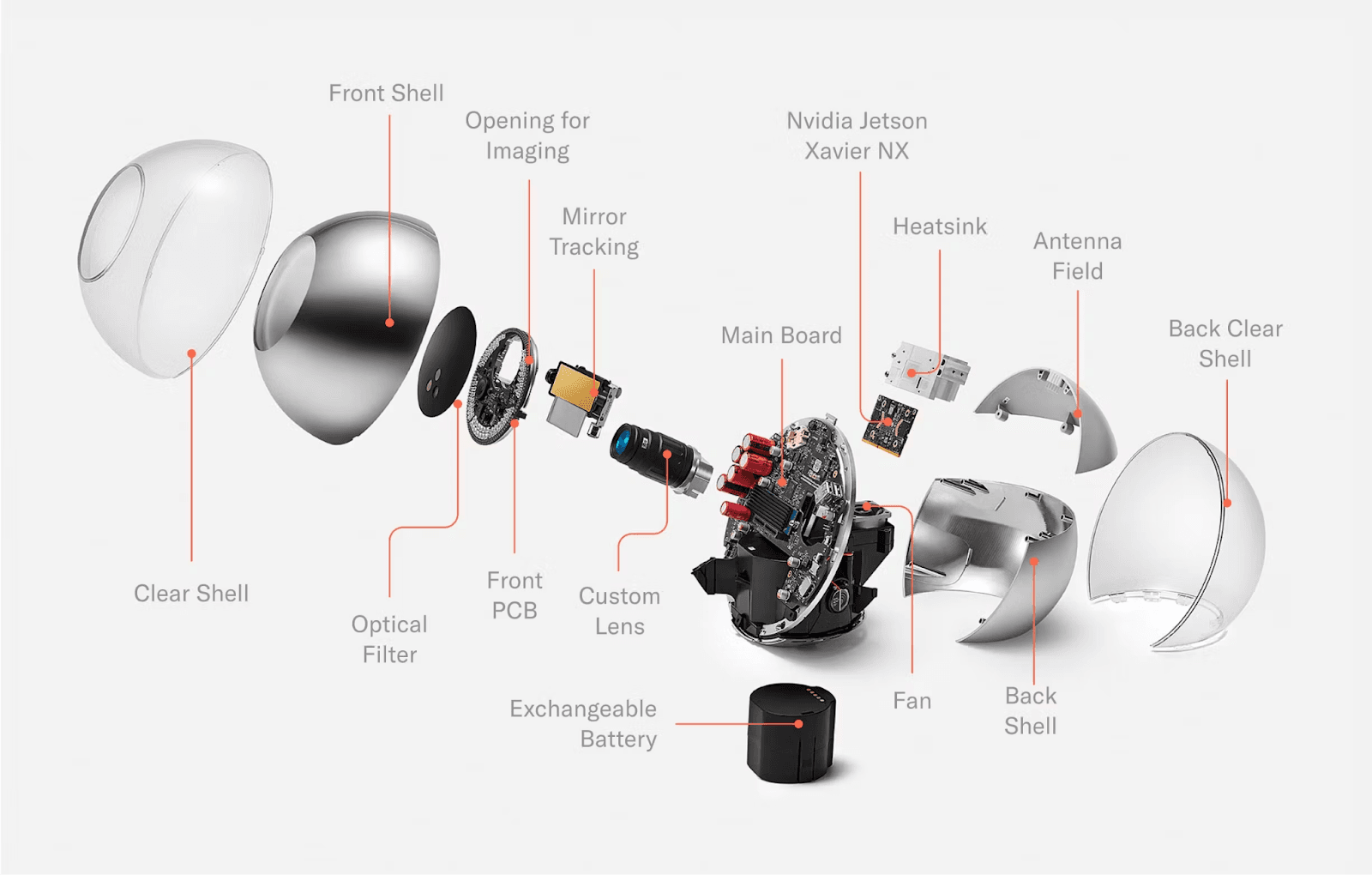
Worldcoin's infrastructure consists of three main components: the Orb, the World ID, and the WLD token.
- The Orb is a biometric hardware device that captures a user's iris pattern. Each scan generates a unique identifier called an IrisCode, which is then converted into a cryptographic hash.
- World ID serves as the user's digital identity. It is designed to verify that a person is human without revealing who they are.
- WLD tokens are distributed to verified users as incentives, tradable on Ethereum-based networks.
When someone registers, their iris scan is processed locally on the Orb. According to the company, the image is deleted after conversion into the hash, and the data is fragmented using secure multi-party computation. This allows the system to check for duplicates across the network without reconstructing the original image. Once enrolled, the user can authenticate as a "unique human" through zero-knowledge proofs. Services that integrate World ID can verify users without learning any personal details, creating what the project calls "proof-of-personhood."
This structure gives Worldcoin two core functions. First, it creates a trusted layer for verifying human identity online. Second, it distributes a globally accessible digital currency to those verified users. Together, these systems aim to prevent fraud, reduce Sybil attacks in decentralized applications, and expand financial access across regions with limited banking infrastructure.
The Vision Behind Worldcoin
Worldcoin's founders view the project as both a social and technological experiment. The ambition is to build a network where every person on Earth can prove their humanity and hold a share of the same digital currency. This would form the basis for a global identity and financial system not controlled by any single government or corporation.
The idea also responds to a deeper trend in digital economies. As AI models become more capable, distinguishing between humans and automated agents will be essential for online governance, voting, and economic participation. A universal proof-of-humanity layer could underpin future systems of reputation, access control, and even income distribution. In theory, this could enable applications like global digital voting, verified participation in decentralized governance, and universal basic income (UBI) programs powered by token distribution.
The Challenges Facing Worldcoin
Despite its ambitious design, Worldcoin faces a range of challenges that go beyond technical implementation.
1. Privacy and Data Protection
The most significant concern involves the handling of biometric data. Worldcoin claims that iris images are never stored and that only hashed representations remain, yet regulators have questioned whether those codes can still be tied back to individuals. Under data protection frameworks such as the European Union's GDPR, any identifier that can be linked to a person counts as personal data. European authorities have launched investigations into Worldcoin's practices, particularly its compliance with consent and deletion requirements.
Even if technically anonymized, the very act of collecting biometric data at scale raises ethical issues. Biometric identifiers are permanent; once compromised, they cannot be replaced. Critics argue that exchanging such sensitive information for cryptocurrency creates an unequal trade, especially in regions where users may not fully understand the implications of surrendering their data.
2. Centralization and Governance
Although Worldcoin describes itself as decentralized, the operational backbone is controlled by Tools for Humanity, a private company. This creates a central point of authority over enrollment, infrastructure, and data processing. If the system becomes widely adopted, a single organization could effectively control access to one of the most important layers of digital identity. For a project built on decentralization, this structural dependence is a major contradiction.
3. Ethical and Regulatory Complexity
The promise of inclusion through financial incentives also raises ethical questions. Offering tokens in exchange for biometric data has been criticized as exploitative, particularly in developing countries where participants may prioritize short-term financial gain over long-term data security. Regulators in several jurisdictions have also flagged issues around informed consent and the transparency of data usage. The potential for governments or corporations to access the biometric database, even indirectly, adds another layer of risk.
Adoption and Practical Limitations
Worldcoin's rollout has been slower than expected. Since launch, around 12 million users have verified their identity, but that figure remains far from the project's stated goals. Many users have reported difficulties accessing Orbs, which are distributed unevenly across regions. Others question the immediate utility of the World ID, as relatively few online services currently integrate with it. Without widespread adoption by developers or institutions, the value of holding a World ID remains limited.
There are also concerns about network effects and concentration of power. If World ID becomes a standard for authentication, the entity that manages it could gain influence over access to digital services, much like how large social media platforms dominate identity verification today. This scenario would effectively replace existing intermediaries with a new one, only this time anchored in biometric verification.
The AI Paradox
Worldcoin's origin is deeply connected to the rise of AI, yet it also reveals a contradiction. Sam Altman's involvement through OpenAI positions him at the center of both accelerating AI automation and building systems to counteract it. While Worldcoin is designed to protect human authenticity online, OpenAI's development of increasingly capable AI agents could make those very distinctions harder to maintain.
To address this, Worldcoin has explored mechanisms where users can delegate their World ID to AI agents, allowing those agents to act on their behalf. This development flips the original purpose of the project which is that instead of simply verifying humans, it could authorize AI entities to operate under human credentials. Such a shift raises complex questions about accountability, authorship, and identity in digital ecosystems dominated by automated actors.
Surveillance and Autonomy Risks
The use of biometric data introduces long-term surveillance concerns. Iris patterns are permanent and unique, which makes them ideal for tracking if linked with other systems. If the Worldcoin database were ever compromised or integrated with state surveillance networks, individuals could be monitored across borders and platforms. This risk is particularly acute in regions with weak data protection laws, authoritarian governments, or where workers are outsourced.
A more subtle danger lies in the normalization of biometric access to digital life. If proving one's humanity becomes a prerequisite for using basic online services, anonymity could erode entirely. In such a future, every interaction might be traceable to a verified identity, turning privacy from a right into a privilege.
The Broader Context
Worldcoin's attempt to merge identity and value distribution is part of a larger movement to redefine trust online. Several other projects, including Proof of Humanity and Idena, have explored different forms of verification without relying on biometrics. The key distinction is that Worldcoin couples identity with economic participation, giving it potential to scale faster but also exposing it to greater scrutiny.
Whether it succeeds will depend on three factors:
Trust — convincing users that biometric verification can coexist with privacy.
Utility — ensuring the World ID is integrated widely enough to provide tangible benefits.
Governance — transitioning from a centralized model to a genuinely decentralized infrastructure.
Without solving these challenges, the system risks becoming either an underused experiment or a powerful yet controversial identity monopoly.
Outlook
Worldcoin embodies both the promise and tension of the next digital era. It addresses the legitimate problem of the erosion of trust in human identity online. However, its solution intertwines high ideals with significant social and ethical risks. The combination of biometric data, corporate control, and tokenized incentives creates a system that could either strengthen digital autonomy or undermine it entirely.
The project's success will depend not just on technical soundness but on whether institutions, regulators, and users can agree on what level of verification the digital world should demand. If implemented responsibly, proof-of-humanity systems could restore integrity to online interactions. If mishandled, they could pave the way for a surveillance-based digital economy where identity and access are controlled by those who own the verification infrastructure.